
Case Study: ODM Sapphire Global School – Student-Led International Collaboration on Teen Fears
ODM Sapphire Global School in India led an ambitious Round Square collaboration that connected 16 schools across six countries and engaged students aged 13–18 in a shared exploration of Teen Fears – Stories of Courage, Culture & Change. Rooted in student experience and shaped by student voice, the project created space for young people to explore common challenges, cultural differences, and global wellbeing through research, storytelling, illustration, and dialogue.
Building on a previous British Council initiative, the collaboration evolved organically when students expressed a desire to expand a similar project beyond two countries. What followed was a carefully structured, six-month process that combined clear planning with genuine student ownership—allowing a student-led idea to grow into a large-scale, international Round Square experience.
A Student-Led Process
While the outcomes were creative and exploratory, the process behind the project was intentionally structured. Planning began around six months in advance, with clearly defined stages, deadlines, and expectations designed to support both teachers and students across multiple schools.
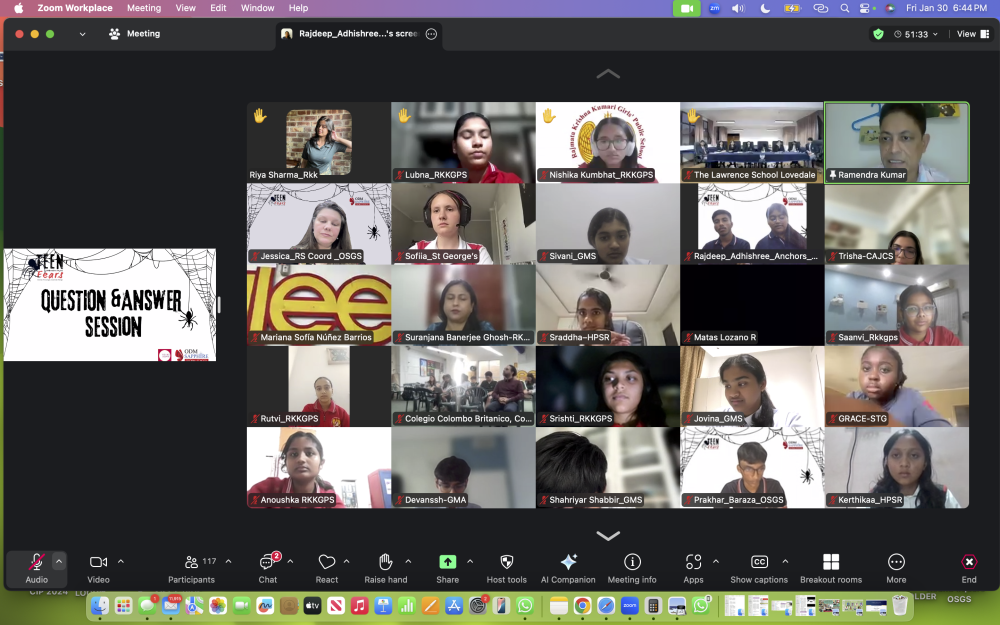
An orientation session marked the formal launch of the collaboration. Coordinators outlined the full journey—from research and creative production to hosting online Barazas—while giving students opportunities to ask questions and shape the direction of the work. This clarity proved critical in keeping 16 schools aligned and engaged throughout.
From there, students took the lead. They brainstormed themes that felt relevant to their own lives and quickly agreed to focus on teen fears. Working collaboratively across countries, they designed and distributed a global survey, which gathered responses from over 400 students. Analysis of the data revealed six dominant fears:
- Academic pressure – fear of failing exams, not meeting expectations or disappointing parents/teachers
- Fear of the future – uncertainty around careers, higher education, finances or global crises (like climate change or war)
- Body image and appearance – pressures to look a certain way, amplified by social media, leading to low self esteem
- Fear of disappointing others – especially parents, teachers, coaches or peers, leading to stress and perfectionism
- Fear of not fitting in – social anxiety, peer pressure and fear of rejection or isolation
- Fear of failure – beyond academics, failing in sports, relationships, creative pursuits or personal goals
As RS Coordinator Jessica Patanaik reflected:
“What surprised us most was the lack of strong support systems for teen mental health. This wasn’t just an issue in India—it was global. Letting students uncover that themselves gave the project real depth.”
From Research to Creative Expression
With the survey data complete, students shifted from analysis to creative response. Writing workshops supported them in developing stories grounded in lived experience, while illustration sessions—led by an ODM Sapphire art teacher—helped students translate emotions into visual form. These sessions addressed both traditional artistic techniques and the thoughtful use of AI-assisted tools, prompting discussions about creativity, ethics, and authorship.
As students collaborated across borders, cultural differences became a powerful learning point. Some fears—such as academic pressure—were universal, while others varied significantly. Concerns around relationships, for example, featured prominently in responses from Colombia but were largely absent in India, opening up rich discussions about culture, norms, and social expectations.
To support this depth of work, ODM Sapphire built time deliberately into the school schedule. Students were given approximately 20 hours during class and free periods for story development, alongside additional evening sessions dedicated to training and rehearsal. Particular emphasis was placed on preparing students to host online Barazas—a new experience for many—through repeated practice and guided reflection.
For Class 9 student and Baraza leader Pritha, this facilitation role was central to the learning:
“My favourite part of the activity was when people finally started opening up about their fears and sharing their thoughts. The sessions were light and engaging, and as a Baraza leader my job was to make everyone feel included and ensure every opinion was heard.
The activity took about 30 minutes, but the time was completely worth it. Everyone participated actively and felt comfortable. I learnt how important it is to create a safe environment, and I developed leadership skills such as managing and understanding different views. I also realised how opening up to others can build trust and connections.”
Challenges, Growth, and Context
As a candidate Round Square school, ODM Sapphire faced additional challenges in embedding this kind of student-led, international collaboration. Many students were taking on public leadership roles online for the first time, and some parents were initially hesitant, prioritising academic study over participation.
Jessica explained:
“Even convincing parents to let their child spend a weekend online leading a Baraza was a mindset shift. We had to show them the value of leadership, communication, and global awareness alongside academics.”
Cultural context added another layer. Many students were first-generation learners, and for some families, participation in international online events was unfamiliar territory. Despite this, students grew rapidly in confidence once they understood the scale and purpose of what they were leading.
Assistant Round Square Coordinator Neha Das observed:
“Once students realised they had the power to shape the project, they poured their energy and creativity into it. You could see their confidence and leadership grow every day.”
That growth was echoed by Arshia, a Class 9 student, Teen Fears core team member, and Baraza leader:
“My experience with the Teen Fears activity was truly meaningful. I met students from different cultures who shared valuable insights about their societies and experiences. It was eye-opening to see that, even though we come from different parts of the world, many of our fears and challenges are similar.
Hosting the event was a completely different level of excitement. We worked together to prepare, share ideas, and talk honestly about our fears, which brought us closer as a team. Through this process, I learnt to open up more confidently and face my own fears instead of hiding them.”
Impact and Insights
The impact of the collaboration was both practical and profound. Students developed leadership, communication, research, storytelling, and design skills while managing real responsibilities in a global context. They learned to facilitate dialogue, meet deadlines, work across cultures, and address sensitive topics with empathy and maturity.
Equally significant were the insights that emerged. The survey findings and subsequent discussions highlighted shared global pressures around mental health, while also revealing how cultural context shapes young people’s experiences. These conversations encouraged reflection not only among students but also among educators, prompting questions about support systems, wellbeing, and the role of schools in addressing these issues.
As Jessica reflected:
“Seeing students turn sensitive topics into meaningful stories and illustrations, while facilitating cross-border conversations, was inspiring. This is what Round Square is about—connection, empathy, creativity, and leadership.”
Looking Forward
The completed stories and illustrations will be compiled into an e-book to be shared across participating schools and featured on ODM Sapphire’s Round Square page. Looking ahead, the school plans to run one major student-led international collaboration each year, with students choosing the theme and leading each stage of the process.
For ODM Sapphire Global School, the project demonstrated that student ownership is key to meaningful collaboration. When students are trusted with responsibility, supported by clear structure, and given time to grow, they rise to the challenge. For a candidate school, the collaboration also helped shift parental and community perceptions, illustrating the value of holistic education that develops confident, capable, and globally minded young people.
As Jessica concluded:
“When students are given ownership, guidance, and opportunity, they exceed expectations. That’s the power of international collaboration done well.”
A Four-Step Guide to a Successful Student-Led International Collaboration
1. Plan Early and Design for Scale (Start 6 Months Ahead)
Effective international collaborations require time. Begin planning at least six months in advance to allow for partner recruitment, student training, and meaningful outcomes. Map the full journey from registration to final sharing, with clear milestones and deadlines. This level of planning supports collaborating schools and prevents the project from becoming overwhelming as numbers grow.
Crucially, design the structure before inviting schools. A well-defined framework gives teachers confidence to commit and creates space for students to focus on creativity rather than logistics.
2. Set the Tone with a Strong Orientation Session
A comprehensive orientation session is essential. Use it to introduce the project’s purpose, timeline, expectations, and outputs to both teachers and students. Walk participants through each stage of the process, share examples, and explain how students will lead.
This early clarity builds trust, reduces confusion later, and helps schools understand that the collaboration is a learning journey rather than a one-off event. It also signals that student voice and ownership are central, not optional.
3. Give Students Ownership—With Guided Support
Place students at the centre of the collaboration from the start. Allow them to shape the theme, design surveys or research tools, lead creative responses, and take responsibility for hosting discussions. Adult coordinators should act as facilitators, providing guidance, timelines, and safeguards, but resisting the urge to control outcomes.
Ownership grows when students are trusted with real responsibility and given time to practise. Build in rehearsal sessions, training for online facilitation (such as Barazas), and opportunities for reflection. Confidence and leadership develop through doing, not observing.
4. Build in Time, Practice, and Reflection
Student-led collaboration cannot be rushed. Allocate dedicated time within the school schedule—class periods, free periods, or zero periods—for research and creative work, alongside additional sessions for training and practice. Rehearsing presentations and online leadership roles is key to success, particularly for students new to international collaboration.
Finally, create a meaningful output such as an e-book, showcase, or shared resource and make space to reflect on learning and impact. This reinforces the value of the process for students, parents, and the wider school community.