
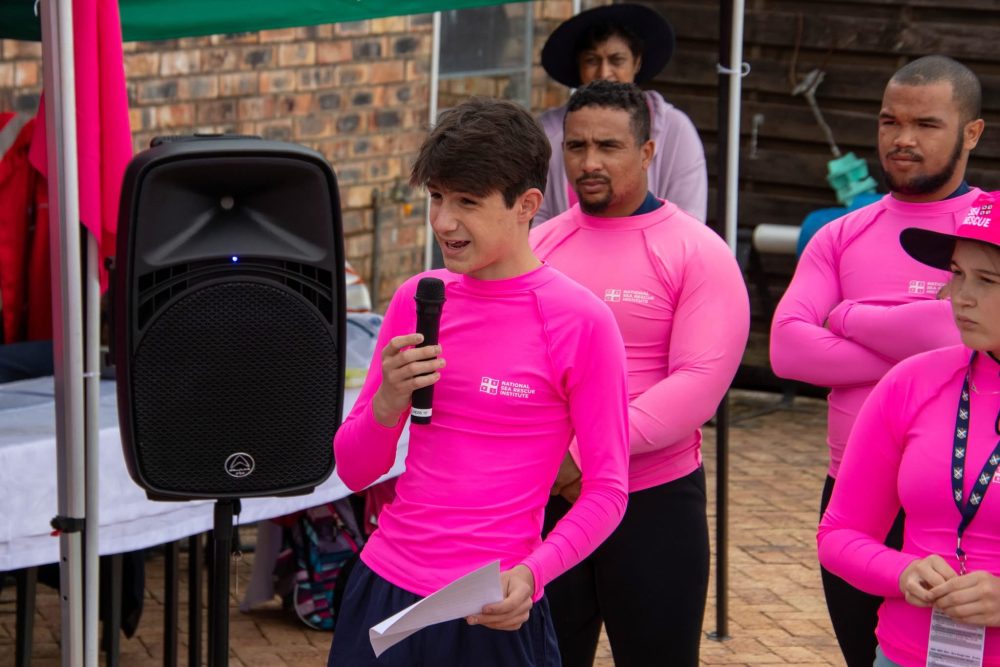
Oliver Hutton, St Andrew’s College – Kurt Hahn Prize, Highly Commended
Whether supporting emergency crews as a volunteer medic, helping communities affected by wildfires, or leading a survival swimming programme that is teaching life-saving water safety skills to local children, Oliver Hutton, a student at St Andrew’s College in South Africa has consistently shown a commitment to serving others with humility and purpose. His initiative helped establish a partnership between the school and the National Sea Rescue Institute (NSRI), making the school the first to deliver survival swimming lessons to children from neighbouring schools. In recognition of his leadership and community impact, Oliver was named Highly Commended in the Kurt Hahn Prize 2026.
“Growing up in South Africa, with a love for water and the ocean, I have seen and heard of many drowning incidents that could have been prevented if people had access to basic water safety skills. My volunteer work with Gardmed Ambulance Services, Coastal Kindness and the National Sea Rescue Institute also made me realise just how important drowning prevention really is.
“The turning point came after a tragic incident in Kenton-on-Sea, where several children drowned in a single day. I had already been volunteering with the NSRI survival swimming programme in Kenton-on-Sea through my family’s connection to the area. When I returned to school, I felt that we had both an opportunity and a responsibility to do more.
“I researched the issue, gathered statistics on drowning rates and water safety, and wrote a proposal to bring a survival swimming programme to St Andrew’s College. I knew our school had the facilities that could make a real difference, and I wanted more students to become involved in helping younger children develop basic survival skills in the water.
“Working alongside staff, fellow students and the NSRI, we launched the programme with 45 children from a local primary school. The aim was never to teach competitive swimming. It was about helping children feel safe in and around water, teaching them what to do if they find themselves in danger, how to help others safely, and how to call for assistance.
“One of the most rewarding parts of the journey has been seeing the confidence those children developed. Many were initially afraid to even stand in the shallow end of the pool. By the end of the programme, they were swimming confidently across the pool. Knowing that they have gained skills that could one day save their lives makes everything worthwhile. Seeing the smiles on their faces when they float for the first time is something I will never forget.
“The biggest challenge has been finding and retaining volunteers. Students are busy with academics, sport and other commitments, and while initially there was strong interest, maintaining that involvement over time was difficult. It taught me that leadership is not only about having a good idea. It is about building a community around that idea and helping people stay committed to a shared purpose.
“Through this experience, I have learned that leadership is about service and community. Without the support of the people around me, I would never have been able to achieve what we have. I have also learned that things do not always go according to plan, and that is okay. You simply need to keep trying.
“Looking back, what makes me most proud is not the programme itself, but the impact it has had on the children who have taken part. If even one child avoids a tragedy because of what they learned through survival swimming, then every hour invested has been worth it.
“What I did not expect was how much the experience would change me. When I first started, I was a fairly reserved student. Over time, as I saw that my actions could genuinely make a difference, I became more confident in my ability to create positive change. That confidence has carried into other areas of my life and encouraged me to step forward whenever I see a need in the community.
“That mindset was evident during recent flooding and fire emergencies in local communities. When families were displaced and people needed support, I helped organise collections of food, blankets and essential supplies, while continuing my volunteer work supporting emergency response efforts. For me, service is not something limited to one programme. It is about responding wherever help is needed.
“Looking ahead, I would like to see the survival swimming programme expand beyond Makhanda and reach more communities across the Eastern Cape, particularly in rural and inland areas. Even where access to pools is limited, water safety education can still save lives.
“Being named Highly Commended for the Kurt Hahn Prize is a great honour. I feel encouraged to have been recognised, but more importantly, it reinforces the value of the programme and the importance of the work being done. It motivates me to continue serving and to keep finding ways to make a difference.”
Four steps to lead like Oliver:
- Start with something you genuinely care about: Choose an issue that matters deeply to you. When challenges arise, passion is what keeps you going.
- Don’t wait for perfect conditions: If there is a need in your community, take the first step. You can learn and adapt as you go.
- Build a team around a shared purpose: Real change happens when people work together. Invest time in bringing others with you.
- Keep going when plans change: Leadership rarely follows a straight line. Be flexible, stay resilient, and focus on the impact you are trying to create.