
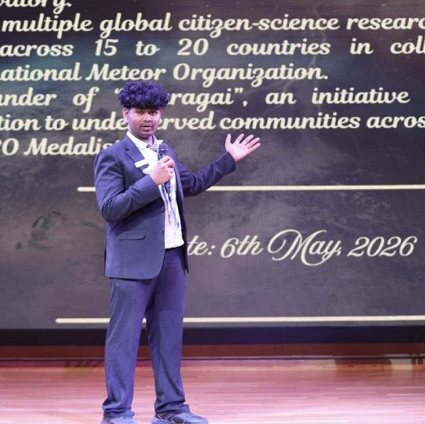
A King Constantine Medal Story – Sriram Jagannath, GEMS New Millennium School, UAE
For Sriram Jagannath from GEMS New Millennium School, UAE, astronomy has never simply been about observing the stars. It has been about access, opportunity, and ensuring that curiosity is not limited by circumstance. Through global citizen science projects, international collaborations, and educational outreach programmes reaching more than 350 students in underserved communities, Sriram has dedicated himself to making astronomy and scientific inquiry more accessible to young people. His work embodies the Round Square IDEALS of Leadership, Internationalism, Democracy, Environmental Stewardship and Adventure, earning him his school’s King Constantine Medal.
“I still remember standing on my grandmother’s terrace on a Tuesday night, gazing at the dusty pinpricks of light scattered across the sky.”
“As a child, that view felt like an ancient map filled with wonder. As I grew older, I began to see something else. For many students, those stars are hidden not only by clouds or pollution, but by a lack of opportunity. A student who has never heard of astronomy, or whose school lacks even a basic science laboratory, can find the pathway into this field blocked long before they ever look through a telescope. That realisation changed everything for me.”
“My love for astronomy became a mission to bridge that gap and make science more accessible. I wanted astronomy to feel less like an intimidating field reserved for a select few and more like something that belonged to everyone. That belief led me to create opportunities for students to explore astronomy, coding and scientific research regardless of their background.”
“One of the most meaningful parts of that journey has been Project Tharagai, through which I have introduced astronomy and scientific inquiry to more than 350 students in underserved communities and government schools across Tamil Nadu. Watching students discover new possibilities for themselves has been one of the most rewarding experiences of my life. More than fifty students have continued their engagement long after their first session, pursuing their own learning and exploration. To me, that is proof that opportunity, once given, can take root and grow.”
“My work has also extended beyond local communities. Through citizen science collaborations involving participants from fifteen countries, I have helped bring together young people across borders to contribute to shared scientific research. These projects demonstrated the power of Internationalism and showed that discovery becomes richer when knowledge is exchanged across cultures and continents.”
“One of the most memorable challenges came during a global observation campaign for the Perseid meteor shower. Months of planning had gone into coordinating observation sites, aligning time zones, and preparing participants around the world. Yet when the long-awaited night finally arrived, clouds covered many of our observation sites. It felt as though months of effort were disappearing behind the weather. But astronomy teaches resilience.”
“Instead of focusing on what we had lost, we concentrated on the locations where skies remained clear. We adapted, refined our methods and gathered the data we could. That experience taught me that success is not built on perfect conditions. It comes from persistence, from finding ways forward when circumstances refuse to cooperate.”
“A similar lesson emerged while mentoring younger students conducting research on exoplanet transits. As we analysed data, atmospheric interference created significant noise in our observations. It would have been easy to accept those limitations, but curiosity encouraged us to keep investigating. Together, we experimented with different approaches until we developed a coding-based solution that reduced the distortions and improved the quality of our results. That experience reinforced a lesson: limitations often become the starting point for innovation.”
“Leadership, for me, has never been about directing others. It has been about creating opportunities. I have guided Grade 6 students through authentic astronomical research projects, giving them responsibility for collecting data, analysing findings and presenting conclusions. Several of these students went on to earn international recognition for their work at just twelve years old. More importantly, they developed confidence in their own abilities and discovered that they could contribute meaningfully to science.”
“Within my school, I have organised expert speaker series and astronomy programmes for younger students, creating spaces where curiosity can flourish and every voice can be heard. These initiatives reflect my belief that learning should be collaborative, inclusive and accessible to all.”
“Receiving the King Constantine Medal is a tremendous honour. To me, it is not simply recognition of what has already been achieved, but a reminder of the responsibility that comes with leadership. It represents the RS IDEALS I have sought to follow throughout my journey: Leadership through action, Internationalism through collaboration, Democracy through participation, Environmental Stewardship through awareness, and Adventure through resilience.”
“Most importantly, it strengthens my commitment to widening access to scientific discovery. Learning should never be the privilege of a few. It should be the inheritance of all. The stars belong to all of us. My goal is to help ensure that every young person has the opportunity to reach for them.”
Four Lessons for Leading like Sriram
1. Let your passion become your purpose
The most meaningful projects often begin with something that genuinely fascinates you. When challenges arise, passion gives you a reason to keep going.
2. Turn obstacles into opportunities
Clouded skies, imperfect data and unexpected setbacks are not the end of the journey. They are often where the most valuable learning begins.
3. Create opportunities for others
Leadership is not about being the centre of a project. It is about helping others discover their own confidence, skills and potential.
4. Make knowledge accessible
Learning should never be limited by geography, background or resources. If you have knowledge, share it. If you have opportunity, create it for others.